 news
Catholic educator and maker of heroes who helped bring freedom to Zimbabwe
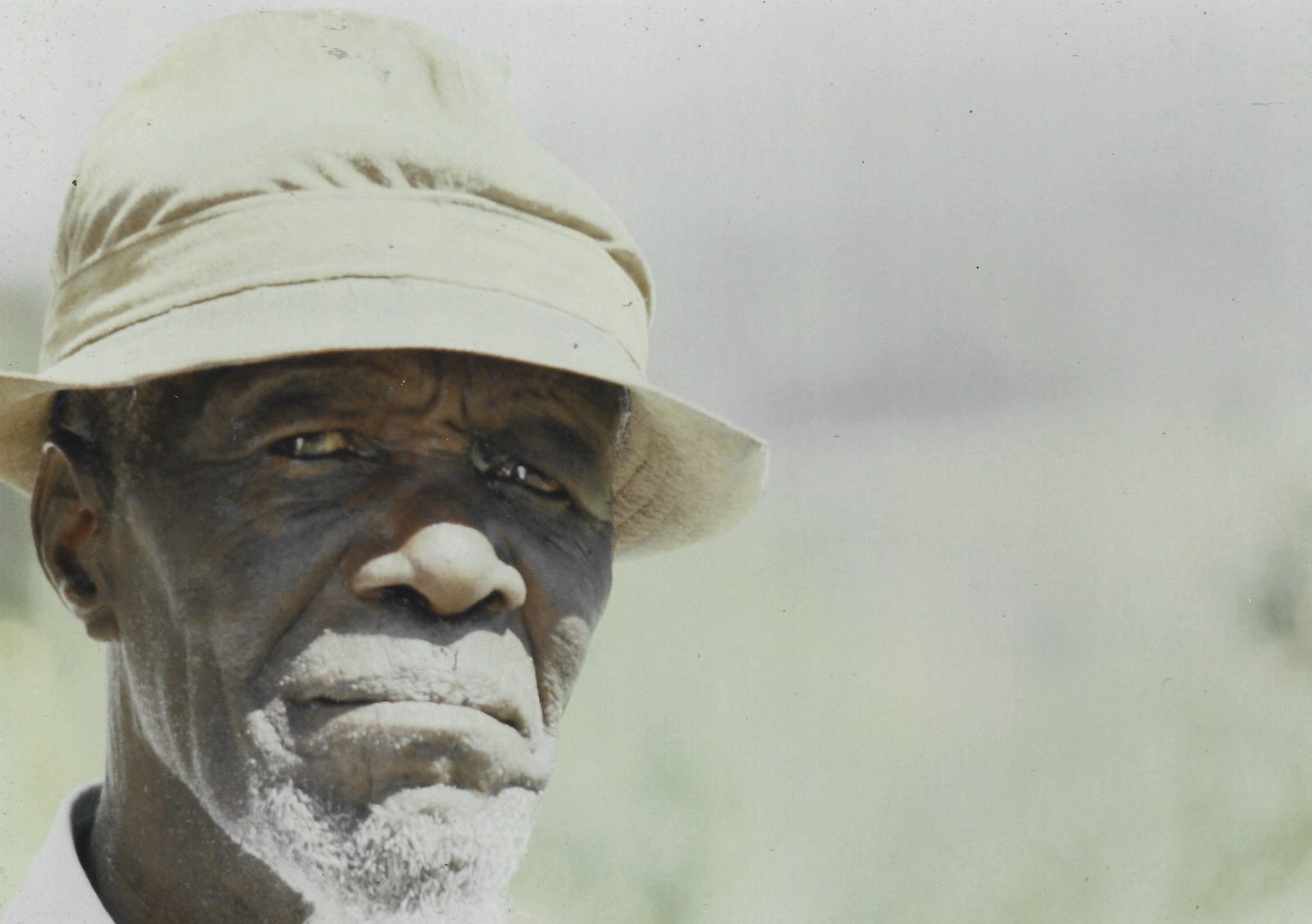
Joseph Dambaza Chikerema, whose work at Kutama Mission Station in Mashonaland helped shape the character of men and women who went on to build Zimbabwe after 90 years of foreign rule. (Picture: Trevor Grundy)
Lawrence Vambe died on September 15,2019. The hole left by his departure needs to be filled by Zimbabwean writers and historians young enough to be his great, great grandchildren. TREVOR GRUNDY remembers him well and re-publishes an article by the widely respected author of ‘An Ill-Fated People’ about Joseph Dambaza Chikerema, whose life and work helped build the platform upon which millions of Zimbabweans stand.
A MAN OF TRUE GREATNESS by Zingizi (Lawrence Vambe) published in the Sunday Mail, May 1982
He was unique: you don’t see people like him anymore, said one observer. No, the people of today are rubbish, commented the other.
The object of this rather sharp eulogistic comparison was none other than the late Mr Joseph Dambaza Chikerema, who passed away in May 15, in 1982, being 99 years of age, but his mind was as clear as ever.
Not by any stretch of the imagination could Zingizi attempt to improve on this kind of simple, honest and touching eulogy, one of so many, particularly the Prime Minister’s. which he delivered in person during the requiem mass in the Harare Catholic Cathedral on the afternoon of May 17, shortly before Mr Mugabe’s departure for Europe.
No one could have traced Dambaza’s life more graphically and fittingly or felt closer to the man than did the Prime Minister. And rightly so.
Joseph Dambaza, as he was popularly known throughout his life, was indeed an extraordinary man in the finest sense of that word. For in him was combined the best ideals and virtues of Shona culture, Western education and Christianity.
These manifested themselves in his almost faultlessly refined manners, extreme kindness and consideration for others, regardless of who they were, but especially in his deep Christian faith and dedication in the service of his fellow man, and without selfish motives.
Born in 1892, if the records are correct, at the recently established Chishawasha Jesuit Mission, he came into a world far more complex than the one his parents had known, but above all a world in which black freedom was now a thing of the past. Mashonaland having been occupied in 1890.
Yet, barely four years old, he was to witness – if indistinctly so, being a child – and lived through the bloody 1896 so-called Mashonaland Rebellion, in which his own father, Chikerema Ushewungani, and other leading Vashawasha, were in the frontline in an attempt to recover their lost freedoms.
However, this heavily thick cloud had its silver lining. For young Dambaza (meaning locus hoppers, having been born when millions of them were about), like many of his age in Chishawasha, was drawn, despite the objections of his elders, into the new values of Christianity and Western education for which the Jesuit Fathers had established what was soon to become one of the leading schools for black people in the country.
And, much to the chagrin as well as astonishment of the white settler community, most of whom believed the Shona, particularly, were the lowest of the low, many of these young men and women proved themselves to have the necessary intellectual capacity to absorb Western knowledge, including playing classical music.
And none more so that did the tall, lithe, even rather arrogant-looking and stubborn Joseph Dambaza, whose intelligence and forceful personality were so marked that he was in the course singled out for a special assignment, as were others, like Lawrence Sawada and Britto Mhembere.
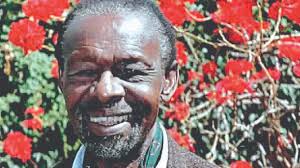
Robert James Chikerema, son of Joseph Dambaza Chikerema. ‘Chik’ was shaped by his father’s Catholicism and went on to become one of the founders of nationalism that eventually ended all-white rule in Rhodesia.(Picture: Trevor Grundy)
This came about in 1914 when he was sent, along with Father Loubiere, to run the newly founded mission station at Kutama, close to the then Zvimba Reserve to serve the special needs of some of the people from Chishawasha who had left the area in order to get away as far as possible from white interference.
For the next 15 years and more Joseph Dambaza devoted all his physical and intellectual energies to the service of the Church and the Kutama people, thus firmly laying the foundations of what is now one of the best schools in Zimbabwe and whose products are found in just about every Government ministry and other important spheres in our country today. This story is surely familiar to most.
What is not familiar perhaps is his association with the Prime Minister’s parents, who got married and who taught at Kutama under the direct tutelage of Joseph Dambaza and of course the French priest.
Having taught Mugabe’s father the trade of carpentry, theirs became a remarkable missionary triumvirate, Dambaza teaching academic subjects, Mugabe woodwork and Loubiere spiritual matters. To which we must add Mrs Mugabe, the first African schoolmistress in the school, if not the whole country.
After the death of Loubiere, Dambaza took a Jeanne’s teachers course, one of the first in the country, designed to train men who were to supervise and to improve the standard of teaching in what were called kraal schools in many remote areas.
And here again, as he did in Kutama, Dambaza threw himself heart and soul into this task because he knew that it would help uplift his under-privileged people and bring them nearer the day when there would be no excuse to deny them the rights to take their place among all free men.
Thus, the Prime Minister, in a gesture typical of his genuine character, was absolutely right in reminding the congregation at the requiem mass that Joseph Dambaza had contributed in no small measure to the freedom we are now enjoying.
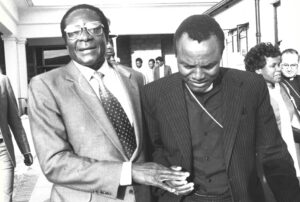
Robert Mugabe, a child of the Catholic Church and Kutama Mission station with the Archbishop of Harare from 1976 to 2003, the Most Reverend Patrick Chakaipa. (Picture: Trevor Grundy)
There could be no better epitaph to this man than those words of Mr Mugabe.
There is no space here to recount Dambaza’s individual struggle against many aspects of racial and colour discrimination which to the younger generation, must appear to be too insane to have been true.
What is remarkable. Yet characteristic of the man, is that at no time did he even think of hating white people as a race nor question the Catholic religion brought in by them. For instance, the harsh disciplinarian school master Father Biehier beat his pupil at Chishawasha school to the extent of breaking his arm.
Dambaza never spoke of Biehier with bitterness. He was too-loft minded and Christian to harbour manifest feelings of animosity, even towards fellow black men who humiliated him in the course of their official duties, such as policemen and clerks at Native Commissioners’ offices.
Indeed, I find it remarkable that, while some men can spend all their lives causing misery and unhappiness to others, men like Dambaza did just the opposite, creating richer and happier life for everyone.
Equally, as an aside, I find it rather remarkable that Zvimba Reserve should have been the breeding ground of such an impressive array f outstanding people in the history of recent memory of this country – such as Matthew and Miskek Zvimba, the Rev. Thompson Samkangea and, of course, the first Prime Minster of Zimbabwe.
As Zingizi’s last sentiment, permit him to say that this country will be all the richer if can retain, cherish and foster some of the ideals and virtues that epitomised the life of Joseph Dambaza Chikerema.
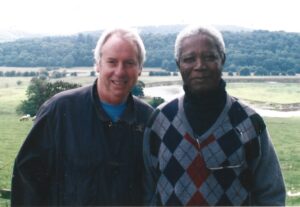
Journalist Trevor Grundy and the late Lawrence Vambe at Ironbridge in Shropshire, England. Picture by Jane Grundy.