 news
Commonwealth (CHOGM) 2026: West Indian academic says the sons of King Charles have benefited from the chattelisation of the African people
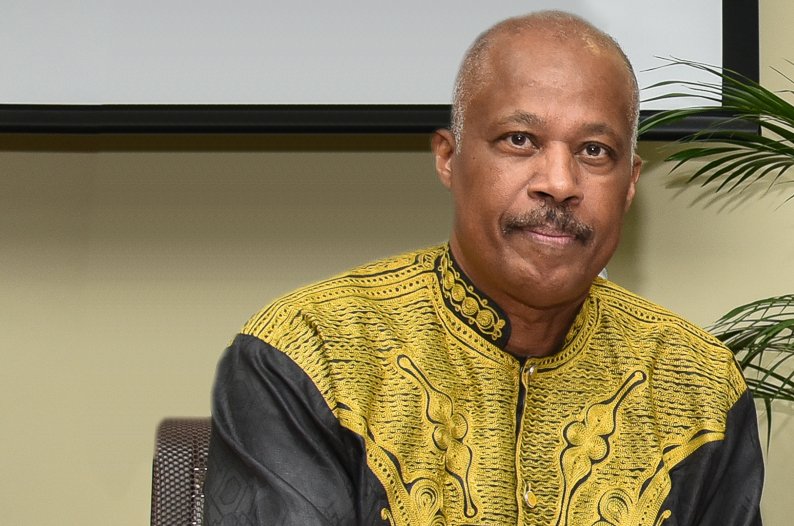
Sir Hilary Beckles – Appealing to Charles, regarded by this prominent academic as a parent and a grandparent who can see the enrichment that slavery has presented to his family.
The Commonwealth has a new buzzword – reparations. It’s on the lips of most of the delegates attending the four-day bi-annual Commonwealth Heads of Government Meeting (CHOGM) which opens in Antigua and Barbuda. The Commonwealth is a British-designed pos-Empire “club” with 56 member states representing 2.7 billion people and its head is King Charles who inherited leadership at the request of his mother, Queen Elizabeth.
by TREVOR GRUNDY
November 3, 2026
There are times when you could mistake CHOGM for a preview of the Eton-Harrow cricket match. A spokesperson for Buckingham Palace told the BBC that Charles’s role was to “bat for Britain.” The historian Sir Anthony Seldon said Charles is chock-a-block with empathy and is sure to “play a blinder.” Author and political commentator Trevor Phillips summed it up succinctly when he said – “The Commonwealth now looks like a club of nations brought together by a passion for cricket, netball and bowls and those most frictional moments amounting to a mild tut tutting when members decide to kill gay men for no other crime than being gay.”
While Charles re-fuels his empathy tank and walks towards a sticky wicket ready to face Caribbean googlies after being caught in a down-pour in Antigua without a royal brolly, one prominent Caribbean activist has allowed his heart to over-ride the unwritten rules of diplomacy at CHOGM club get-togethers.
Cynics say the acronym really stands for Comrades Holidays on Government Money.
Sir Hilary Beckles is the chairman of the reparations commission for Caricom, a group of Caribbean states all calling for reparation. He is also Vice-Chancellor of the University of the West Indies.
He told The Times newspaper (October 31, 2026) that he is calling for a ” dialogue of decency” on the subject of slavery and reparations. He said that the region is “mobilised” and has never been better prepared to confront Britain and the monarchy over their ties to slavery.
In a report written by Kate Mansey headlined “Charles must fight for Commonwealth” Beckles said – “I’m appealing to Charles Windsor, a parent, a grandparent. He can see the enrichment that slavery has presented to his family. He can see that the wealth he’s passing on to his children and his grandchildren all came out as significant sums to this process of the chattelization of the African people.”
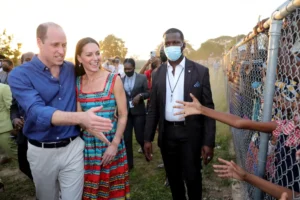
HANDS ACROSS THE OCEAN: William and Kate saying ‘hello’ to young Jamaicans during an embarrassing royal tour in 2022.
Has anyone so prominent said anything to explosive as this before?
After Charles departed Nassau on Thursday last week, his spokesman said the King was “delighted” to return to the islands “which have a special place in his heart.”
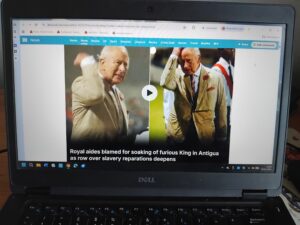
LONG TO RAIN OVER US: Charles caught in a Caribbean downpour without a royal brolly. A furious soaking wet monarch has captured headlines around the world and CHOGM hasn’t started yet. Royalists hope that its not the only soaking he’ll get this week.
However, the country’s prime minister Philip Davis said that the Bahamas would be open to removing Charles as its head of state. He said – ”That’s a question for my people. I’m open to it, yes.”
How many other leading Caribbean politicians also believe that the Commonwealth needs an elected and not an appointed head remains to be seen.
Reparations. Old as the hills but now the latest Commonwealth buzz-word.
Perhaps the most famous in the 20th century was Germany paying Israel after the Holocaust.
The academic Katrin Bachleitner of the Department of Political Science at Oslo University in Finland said that Germany’s agreement to pay reparations to Israel marked a significant moment in post-World War II history.
In 1951, Israel’s government formally initiated discussions for reparations from West Germany, emphasizing the need for financial support to rehabilitate Jewish survivors and assist in their resettlement. Chancellor Konrad Adenauer’s acceptance of responsibility for Nazi crimes initiated a series of negotiations, culminating in the Luxembourg Agreements signed in 1952.
Although some opposition existed regarding negotiations with Germany, the reparations represented a moral step towards reconciliation.
Under the terms of the Luxembourg Agreements (September 10, 1952) West Germany agreed to pay $865 million to Israel for damages suffered by the Jewish community under National Socialist rule. The government of East Germany refused to assume any responsibility or to participate in the negotiations.
The Luxembourg Agreements were a fundamental step in West Germany’s attempt to move the new Germany away from the Nazi legacy and one of the cornerstones in a future relationship between Germany and the Jewish people.
The 1952 Luxembourg Agreement between West Germany and Israel provides a model for reconciliation through acknowledgement and reparations.
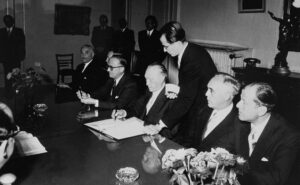
Konrad Adenauer, Chancellor of West Germany, signing the Reparation Agreement between Israel and the Federal Republic of Germany in Luxembourg on September 10, 1952
Konrad Adenauer, chancellor of West Germany, signed the Reparations Agreement between Israel and the Federal Republic of Germany in Luxembourg on Sept. 10, 1952. Photo credit: United States Holocaust Memorial Museum, courtesy of Benjamin F
Reparations were deeply unpopular among West Germans after World War II. In West Germany, the idea of accepting collective guilt was widely rejected amid the postwar climate of public silence. If anything, West Germans remembered their own victimization under the war, the Allied bombings, and the occupation, but not their role as perpetrators of the Holocaust (a term that emerged only later).
The concept of reparations was also extremely unpopular in Israel. First, reparations were widely considered a form of “blood money” from the Germans—an idea that enraged the victims of the Shoah. Second, the policy promoted victim’s shame, which manifested in Israel through the reinforcement of harmful narratives that diaspora Jews let themselves be “led like sheep to the slaughter.” Finally, facing the past and the perpetrator of the genocide reopened the emotional wounds of survivors who were mostly still silent about the traumas they had experienced.
Frantz Fanon on reparations in’ The Wretched of the Earth’
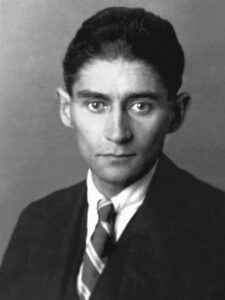
Frantz Fanon author a book that continues to influence young as well as old West Indians.
He wrote: “Not long ago Nazism transformed the whole of Europe into a veritable colony. The governments of the various European nations called for reparations and demanded the restitution in kind and money of the wealth which had been stolen from them: cultural treasures, pictures, sculptures and stained glass have been given back to their owners. There was only one slogan in the mouths of Europeans on the morrow of the 1945 V-day – Germany must pay. Herr Adenauer, it must be said, at the opening of the Eichmann trial (in Jerusalem, 1961) and in the name of the German people, asked once more for forgiveness from the Jewish people. Herr Adenauer has renewed the promise of his people to go on paying to the state of Israel the enormous sums which are supposed to be compensation for the crimes of the Nazis.”