 news
newsMandela Day 2026: A time for Commonwealth leaders to open eyes wide shut
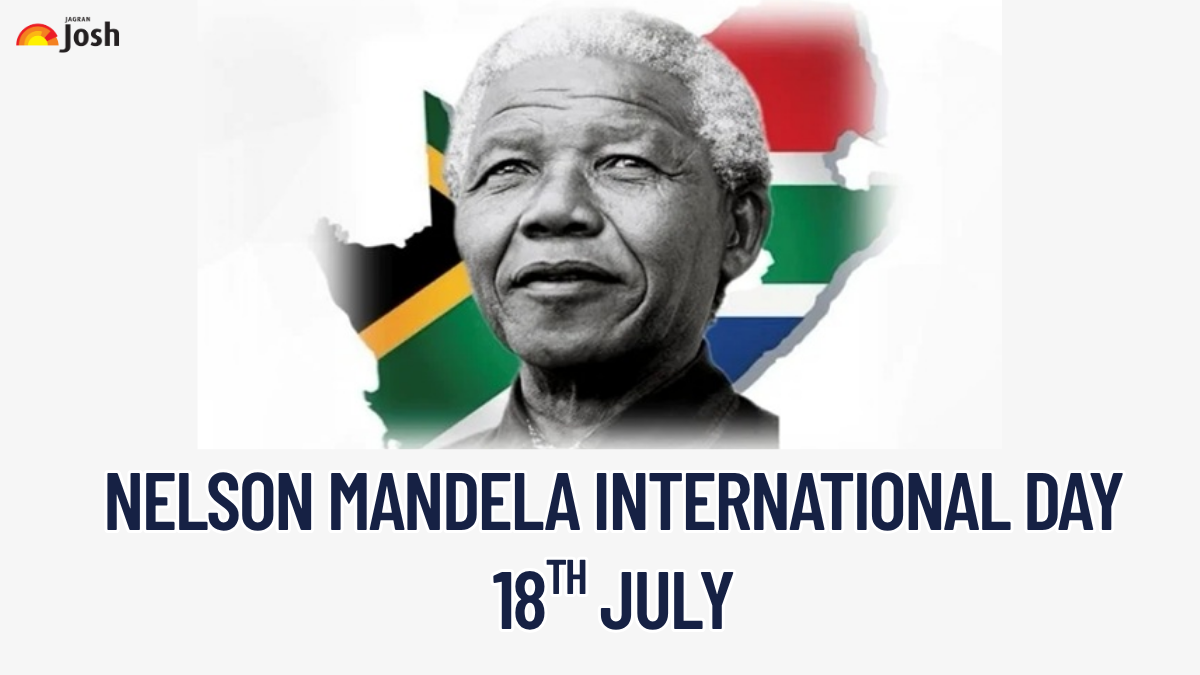
In South Africa, July 18 is known as Mandela Day. There is no need to remind readers of this website what a great man he was and how his lifework was to end racial and ethnic xenophobia. TREVOR GRUNDY, who lived and worked as a journalist in Johannesburg when the Soweto Uprising tore the country apart in June 1976, wonders why so many top flight Commonwealth reporters and politicians are silent when it comes to writing about the frightening wave of xenophobia sweeping across the country.
Nelson Mandela, the anti-apartheid hero, fought against discrimination based on skin colour.
When he was released from prison in February 1990, hopes were high that the days of discrimination based on ethnicity were over and done with.
Today, South Africa’s friends wish the country well but most of them stay as quiet as church mice when it comes to talking about the hell that has broken loose there.
Hardly a soul in Britain has spoken out against the forced removal of tens of thousands of men, women and children originally from Malawi, Mozambique and Zimbabwe.
Commonwealth leaders ignore what is happening.
Everything will come right if we look the other way. Moderation in everything etc.,
For example, what is impeachment threatened Cyril Ramaphosa doing to end the violence?
Next to nothing.
Local elections are approaching in November.
Opposition parties have an incentive to stoke-up anti-government sentiment. There’s plenty of that around. South Africa is one of the most unequal societies in the world.
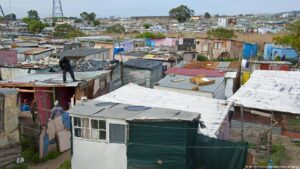
The rich get richer . . . the poor have children, many of them brough up in homes that have little changed over the decades of ANC power
Some in South Africa say that America and Britain have no right to criticise. European and North Americans patrol their streets looking for illegal immigrants.
So, what right do Brits and Americans have to criticise what is going on in South Africa?
It’s a question and a good one.
Sadly, hardly a soul in the Commonwealth opens his or her mouth to say a word – either to improve South Africa’s image or condemn widespread and fast-growing hatred of foreigners.
The Commonwealth , which has been reduced to little more than an annual royal hat and handbag show at Westminster Abbey, says nothing.
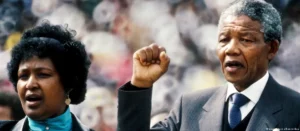
In 1990 – living legends Winnie and Nelson Mandela
Many young black South Africans now ask what has changed since Mandela became head of state in 1994.
They say when hopes were high, they asked for water and electricity in long neglected townships – water, electricity, food, clothing, education as well as elections.
Today, the economy is dominated by foreign mineral monopolies and cheap labour from other countries.
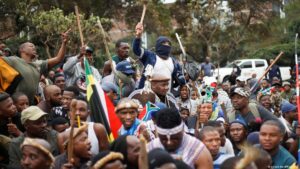
From Rainbow to Rambo in 32 years: Militants on the march looking for unwanted undocumented foreigners.
In 1994, there was a belief that all would prosper. No longer. Fat cats rule.
Zvigananda Is a term used in Zimbabwe and other parts of Africa to describe a small group of politically connected individuals who accumulate vast fortunes of wealth through corrupt patronage and state patronage.
As Ozymandias said in Shelley’s sonnet – ‘Look on my works, ye Mighty, and despair.’
A single voice tells part of the story succinctly.
Tessa Dooms is a sociologist and founder of the NGO Rivonia Circle.
She gave an interview to Deutsche Welle to mark the birth of Mandela in 1918.
She said –
“A special form of apartheid still exists, as if nothing had changed in 1994. People continue to live as rich and poor, as black and white, as if nothing had changed – that is part of the difficulty. The real reason this country has failed to overcome its divisions is that we have not tackled, or dismantled, inequality. We have allowed wealth to accumulate, the only difference today is that this wealth now accumulates in the hands of a political and economic elite. It ignores the majority of the poor, who happen to be black as well.”
Today, millions of South Africans would like to raise glasses and toast the Great Man.
In the glasses of the elite – expensive, bubbly, champagne.
In the cups of the poor – next to nothing at all.
Trevor Grundy is a life member of the National Union of Journalists (NUJ) and the Commonwealth Journalists Association (CJA)