 news
newsZimbabwe towards its 50th year: As George Orwell said -“All animals are equal but some are more equal that others.”
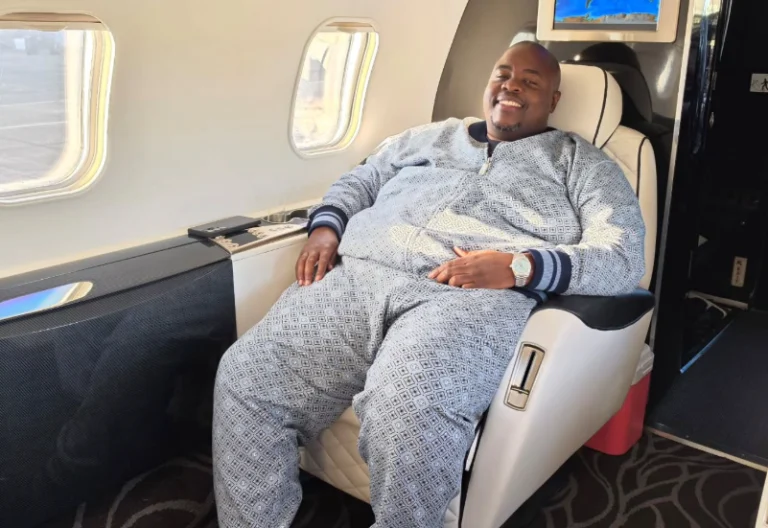
The late “Sir” Wicknell Chivayo . . . he was part of a new breed of mega-rich men and women with the Midas touch, thanks to their close ties with those at the top of the ZANU (PF) money/influence tree.
As Zimbabweans start thinking about the 50th anniversary of their Independence, those famous words about equality and inequality from “Animal Farm” can’t be far away from the minds of George Orwell fans in a country with one of the highest literacy rates in Africa. An invited Special Correspondent takes the temperature of ordinary people which is rising day-by-day as they learn more and more about the staggering wealth of the few against the growing poverty of the many.
Kenya’s President, William Ruto, called him a dear friend whose warmth touched many people. His former deputy, Rigathi Gachagua, was less sentimental, claiming in Boston four days after the crash that Wicknell Chivayo had been holding more than KSh1.5 trillion of Ruto’s money, and that the President had gone berserk at its loss. Tanzania’s President, Samia Suluhu Hassan, flew into Harare on 6 October under a media blackout, with mourners and journalists forbidden to photograph her, and stayed barely half an hour at the Chivayo home. What brought her, nobody has said. On the terraces in Harare, CAPS United supporters had offered a blunter tribute. They chanted that there were only two thieves they hated, and Chivayo was one of them.
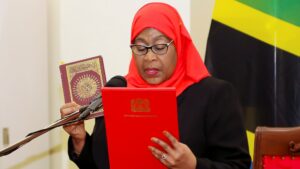
President Samia Suluhu Hassan of Tanzania made an un-scheduled visit to see Chivayo.
God help the journalist who dares to ask ‘why?’
Both verdicts are now academic. On the evening of Wednesday, 30 September, the Bell 430 helicopter in which he was travelling came down at Kudenga Farm near Marondera. Even the casualty figure has wobbled. Police and the government spokesman first spoke of six people aboard. The Cabinet later named five dead: Chivayo, his wife Lucy Muteke, her aide Sanelisiwe Magagula, and the pilots Calvin Soda and Courage Mutavira. The man who styled himself Sir Wicknell, though no monarch ever knighted him, is gone.
What he leaves behind is a question that should have been asked three years ago. He had served prison time for money laundering two decades earlier. His US$172 million Gwanda solar contract of 2015 had still produced no power station, though, surprisingly, the courts acquitted him of defrauding the power company over it. How did such a man give away tens of millions of dollars in public, naming each recipient and each dealership, without ever being required to say where the money came from?
The giving was never hidden. It was the entire point. An analysis of his own public announcements, reported by ZimLive in August, put the total at more than US$43.9 million to more than 120 recipients between March 2024 and July this year, an average of some US$52,000 a day. These are announced gifts, not audited payments. The pattern itself is beyond dispute, because the man published it himself.
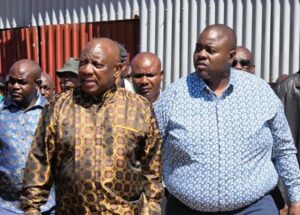
All pals together: Mega-rich Chiveya (right) with one of Africa’s richest presidents, South Africa’s Cyril Ramaphosa
After the 2023 election the cars went to the musicians and rally performers who had sung for the ruling party, and the gifts were announced as thanks for exactly that. A ZANU-PF Member of Parliament, Scott Sakupwanya, received a Rolls-Royce Ghost. A ZANU-PF councillor and singer, Sandra Ndebele, received a Mercedes reported to be worth US$155,000. Two presenters at a radio station belonging to the state newspaper group received cars, after which Zimpapers capped staff gifts at US$100. In May 2025 the veteran ZBC journalist Reuben Barwe was given US$100,000 and a Land Cruiser. Pigs do not ask where the swill comes from; they wallow in it, grunt their thanks, and wait for the next bucket.
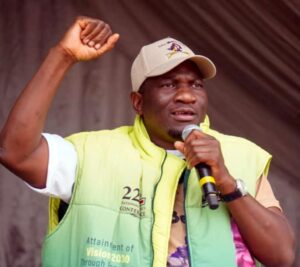
Up-and-coming business/politician Pedzai Scott Sakupwanya
The pulpit did better still. Bishop Nehemiah Mutendi of the Zion Christian Church is reported to have received more than US$4 million, the first million delivered at Easter 2024 after Chivayo arrived on the President’s helicopter. Challenged this year over what critics called dirty money, the bishop said he wanted more. Only one church leader on record turned down an offer of US$2 million. Eunor Guti’s refusal deserves remembering.
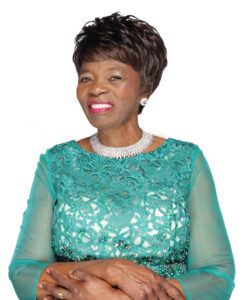
Mai Eunor Guti, Apostle of the Forwards in Faith Ministries
She turned down a Chivayo offer of US250,000 and a brand new brand new Land Cruiser
On Independence Day this year the philanthropist of unexplained means offered Parliament itself. The sum was US$3.6 million, or US$10,000 for each of 360 legislators, announced with the boast that the Principal had given his express approval on the way to church. The ruling party’s youth league objected on 20 April. The next day Chivayo withdrew the offer and announced a revised pledge of US$5 million, US$500,000 for each province, to be channelled through party structures. Whether any of it was paid has never been shown. The public objection came from the party, not from Parliament.
Last December came the most remarkable gift of all. On Unity Day, 22 December, he announced 20 Toyota Land Cruiser 300s and US$2 million in cash for the Christmas cheer funds of the Defence Forces, the Police and the Prisons Service, some US$5.6 million in all. The Herald reported that the cash would be distributed subject to the President’s approval. The Police Commissioner-General’s fund was allotted five Land Cruisers and US$500,000, from a man whose wealth the police had every reason to examine.
So, who in authority was ever going to ask him anything? Or has authority been complicit, or dumbed down to a cowardly, captured bunch fearful of offending the ‘shefu’?
The Zimbabwe Anti-Corruption Commission, to be fair, did open files. A leaked internal memo, which ZACC insiders confirmed to an online outlet as authentic, showed investigators examining his unexplained wealth from May 2023 and serving warrants on two Harare car dealers. Chivayo answered by pledging another 50 cars. In June 2024 the commission’s chairman, Michael Reza, promised there would be no sacred cows in the election-materials affair. In December 2025 he announced that the inquiry had found no evidence linking Chivayo to fraud. Investigators, he explained, had gone to Chivayo, and he had said the same as everyone else. An investigation took place. Its method was to ask the man concerned, and accept the answer.
ZIMRA’s silence is louder. Online media reported in 2023, citing ZIMRA sources, that some US$1.5 million in duty on four new Rolls-Royces and two other luxury cars had been paid in cash, and that the central bank could find no evidence the money had been transferred from Zimbabwe. The 2023 ZACC memo recorded ZIMRA’s own view that his company appeared to be behind on its tax. The Zimbabwe Independent later reported that South Africa’s Financial Intelligence Centre had shared its suspicious transaction reports with ZIMRA. If those reports are right, the revenue authority had another country’s homework on its desk, and there is no public sign it was ever marked. Any police station of 40 years ago would have opened a docket on a man paying cash duty on Rolls-Royces.
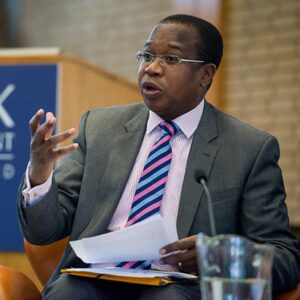
Finance Minister Mthuli Ncube . . .
. . . not illegal to be found with possession of lots of money
Parliament managed one question. In March this year the Member for Imbizo, Mr Madzivanyika, asked whether Home Affairs investigates people such as Wicknell Chivayo. The Minister of Finance, Mthuli Ncube, replied that it is not illegal to be found in possession of large sums of money at all. The statute book disagrees. Section 22 of the Bank Use Promotion Act, as rewritten in 2018, makes it an offence for any private person to hold more than $10,000 in cash without good cause, and section 11 obliges traders to bank their surplus cash by the next business day. Even that is beside the point. The question was where the money came from. A month later the same Parliament was offered US$10,000 a head.
Nor was the law wanting. In 2019 the Prosecutor-General obtained an unexplained wealth order from the High Court against a former chief executive of ZINARA, freezing his assets until he could account for them. The tool was in the cupboard. Nobody opened the door.
South Africa at least looked. A leaked Financial Intelligence Centre analysis, reported in the press but never confirmed by the Centre, indicated that more than R800 million of the R1.1 billion Zimbabwe’s Treasury paid the Johannesburg printer Ren-Form CC for the 2023 election materials flowed on to accounts linked to Chivayo. Ren-Form denies wrongdoing and calls him its agent, and no court has tested any of it. In July this year the Hawks stated that they had no case against him in their system, and News24 apologised for reporting otherwise. In the end it was a divorce application, not a state agency, that persuaded a South African court to freeze his assets there, private jet included. The most effective investigator of Wicknell Chivayo’s fortune turned out to be his former wife’s lawyer.
So were the officials frightened, or were they fools? The record suggests a third answer. No instruction to look away has ever surfaced, and perhaps none was needed. When the police cheer fund has been promised a man’s Land Cruisers, and the soldiers’ Christmas cash waits on the President’s approval, an official weighing a docket can read the situation without being told. Silence of that kind requires neither cowardice nor stupidity. It requires only comprehension.
Four years to go before Zimbabwe’s 50th anniversary of Independence.
More of the same, a complete overhaul or forward to the past?
One man inside the system did ask, and loudly. At Victoria Falls in June 2025, Vice-President Constantino Chiwenga warned that cartels using political connections to win tenders faced a day of reckoning. ZimLive and others reported that on 17 September 2025 he tabled a dossier at the politburo naming Chivayo alongside Kudakwashe Tagwirei, Scott Sakupwanya and Delish Nguwaya, alleging that more than US$3.2 billion of state funds had been stolen, and demanding arrests. These were Chiwenga’s allegations, not findings, and the party spokesman, Chris Mutsvangwa, called the document forged. A reply drafted by the Justice Minister, Ziyambi Ziyambi, actually called it treasonous. Three months later Chivayo was making gifts to the army Chiwenga once commanded.
The Mail & Guardian argued last year that the gifts were aimed at people who would back the President’s continuation in office and his preferred successor, and that the tenderpreneurs had good reason to fear a Chiwenga presidency. Constitutional Amendment No. 3 has since become law, and the International Crisis Group describes the Vice-President as weakened.
Then the helicopter fell. The Civil Aviation Authority’s director-general was describing a fuel spill and a grass fire within a day, which a sceptical public noted. A preliminary report is promised within 30 days, around the end of this month. The day after the crash, Malawi’s Anti-Corruption Bureau arrested its former army commander, General Paul Valentino Phiri, on five counts of abuse of office and dealing in terrorist property, arising from alleged arms trafficking in June and July 2025. Chivayo had at that time enjoyed a close relationship with Malawi’s then president, Lazarus Chakwera. Nothing on the public record connects him to the general’s case.
The timing is a coincidence, and coincidence is not evidence. In a country with a long memory of convenient accidents, many Zimbabweans have drawn their own conclusions regardless. There is no verified evidence that the crash was anything other than an accident. The cure for suspicion is the same as the cure for the money question. Publish the report in full, flight recorder data included.
Into the silence has poured the rumour mill. A British-styled publication calling itself The National Voice has set out a regional cartel of arms, drugs and presidents with Chivayo at its centre and Sudan as the final destination. Another writer has pronounced the crash an execution. Neither offers verifiable sourcing. The cartel’s most arresting figure, Chivayo holding KSh1.5 trillion for Kenya’s President, is borrowed from Gachagua’s Boston speech and is no better evidenced there. It would amount to more than a tenth of Kenya’s entire public debt. The only drug connection in the reputable press, reported by Daily Maverick, runs through a former business associate named in Zambian court papers in 1985, not through Chivayo himself.
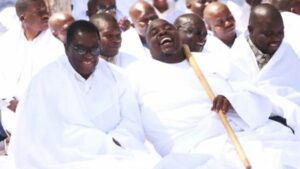
President Mnangagwa of Zimbabwe with the Chiveya (holding rod) at a meeting of Apostoliscs
But rumour is what a state earns when it declines to answer. A government that would not explain a man’s fortune while he lived can hardly complain when strangers explain his death for it.
One test remains, and it costs nothing. The law does not die with the man. In November 2019 ZACC wrote to the Master of the High Court noting its interest in the estate of a deceased accused in a ZINARA fraud case, and sought civil confiscation of US$4.7 million under the Money Laundering and Proceeds of Crime Act. Chivayo’s estate must now pass through the same office.
Will anyone at ZACC lodge an interest this time? Will ZIMRA ask the executors for the returns it never asked of the man? Or will the smoke be allowed to clear, as smoke does, while everyone who was warmed by the fire agrees there never was one?
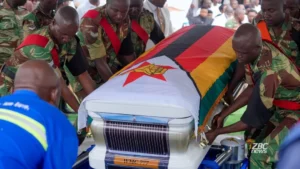
Chiveya’s coffin . . . flamboyant until the end
And the people? They jeered from the terraces and then went home. The bill for every Land Cruiser and every bundle of cash will find its way to them in the end, and they will tighten their belts once more. They have, after all, allowed ZANU-PF to entrench itself so thoroughly that the belt is now the only thing left within their grasp. Is that contentment, or merely the silence of a people who have stopped expecting an answer?