 news
newsThe Pungwe Parliament: What will Zimbabwe pay when CAB3 passes?

President Emmerson Mnangagwa – the people’s choice, or just the number one favourite of a bunch of out-of-touch and corrupt money-spinners?
Instead of debating whether CAB3 should pass, we should be asking what happens after it does. What exactly changes, who benefits, and who pays, asks Special Correspondent ANDREW FIELD
THE DEBATE over Constitution Amendment Bill No. 3 is beginning to feel uncomfortably familiar. Not because Zimbabweans are law experts, but because the atmosphere surrounding it carries echoes of something many recognise instinctively. It resembles a pungwe. As this is written, ominous thunder rolls across the Marondera plateau in the dead of winter, hail falling on the highveld in June, a month when the sky has no meteorological business producing any of it. What is happening outside is, by every climatological measure, an anomaly
The pungwe was a feature of Zimbabwe’s liberation war, a gathering of rural civilians by insurgents, political education by night, compliance enforced, attendance not optional, agreement not negotiable. Whether the comparison is entirely fair is almost beside the point. The fact that so many people are making it should concern us all. When the dry season thunders, something has gone wrong with the natural order. Zimbabwe should pay attention to both warnings simultaneously.
The events of 4 June only reinforced that perception. Parliamentary proceedings were reportedly suspended after Members of Parliament received death threats. Even members of the ruling party acknowledged receiving threats. Constitutional amendments are not normally debated in an atmosphere where legislators are worried about their fate.
The bill will pass. ZANU-PF possesses the parliamentary majority required to ensure that outcome. The Law Society of Zimbabwe says it is unconstitutional. Catholic bishops have rejected it clause by clause. War veterans have challenged it in the Constitutional Court. None of that will alter the final vote. Instead of debating whether CAB3 should pass, we should be asking what happens after it does. What exactly changes, who benefits, and who pays?
The legal position is not ambiguous, whatever the ruling party claims. The Law Society’s formal submissions were unequivocal: the term-extension clauses cannot apply to a sitting officeholder without a national referendum, and the drafters knew it. Their solution was to insert a “notwithstanding” provision that simply decrees the relevant constitutional safeguard does not apply. The government’s counter-argument, that the bill changes the electoral cycle rather than term limits, is semantic gymnastics. President Emmerson Mnangagwa’s term expires in 2028. Under CAB3 it runs to 2030. The constitution addresses substance, not labels.

Only three thousand people were against changes to the constitution? Believe it if you want to.
Supporters point to the public consultation as evidence of overwhelming support. Parliament’s committees reported more than half a million submissions in favour and fewer than three thousand opposed. Perhaps those figures are accurate. Perhaps they are not. Yet even if entirely correct, what do they prove? Zimbabwe is not a country in which political opinion is always expressed freely; with the seated memory of consequences overlap. The public hearings were marred by intimidation. Armed police were deployed at lawyers’ offices. Civil society withdrew entirely, declaring the process fundamentally flawed. Attendance and agreement are not always the same thing. The pungwe functioned to plan.
Here the argument must be made honestly. Is this not simply Africa doing what Africa does best? Liberation movements across the continent have often transformed wartime legitimacy into long-term political dominance. Constitutions are amended. Incumbents seek advantage. Zimbabwe is hardly unique in that trajectory. Nor can the opposition entirely escape responsibility for its present condition. The Citizens Coalition for Change fractured through personality-driven dysfunction that made ZANU-PF’s coerced unity look like a political asset. If no realistic electoral challenge exists, some will argue that CAB3 merely formalises what is already visible to everyone.
That argument is tempting. It is also incomplete. Constitutions are not written for today’s politicians. They are written for our tomorrows. Their purpose is not to protect strong oppositions but to constrain powerful governments, including future ones whose character we cannot yet know. The architecture CAB3 builds makes that point concretely.
Strip away the constitutional language and what CAB3 actually builds is a self-perpetuating apparatus. The voters’ roll moves from an independent electoral commission to the Registrar-General, a direct presidential appointee. The popular election of the president is replaced by a parliamentary vote, meaning ZANU-PF’s legislators choose the head of state. The National Peace and Reconciliation Commission is dissolved. Gukurahundi’s unresolved wound does not disappear with it. It waits, in Matabeleland and beyond, for the conditions that reopen it. The path to permanent one-party autocracy is not a risk of CAB3. It is its very objective in poor disguise.
Perhaps the most significant consequence has received surprisingly little attention. CAB3’s supporters present it as a mechanism for stability. It may instead generate instability considerably more dangerous than any electoral contest. The cold war between incumbent and aspiring presidentials is no secret. Vice President Constantino Chiwenga put President Mnangagwa in State House in November 2017. Gratitude in ZANU-PF politics has a remarkably short shelf life. The 2030 agenda is partly an instrument for keeping the one in office past the point at which the other expected to inherit.

Vice-President of Zimbabwe, Constantine Chiwenga . . .
. . . he put Emmerson Mnangagwa where he it today – but for how much longer?
The military-linked old guard has been angered by Mnangagwa’s embrace of politically connected businessmen who have grown conspicuously, indeed boastfully, wealthy through proximity to state power; men whose business empires expanded through influence over resource allocation and concessions never competitively tendered. The blueprint is not designed for Zimbabwe. It is designed for the people already positioned inside it.
When succession depends upon parliamentary arithmetic rather than a national vote, the decisive contest moves inside the ruling party itself, where it has no constitutional rules, no public accountability, and military institutional interests actively in play. Zimbabwe has already experienced one transition driven by internal power struggles. CAB3 recreates those structural conditions. Not because anyone necessarily plans a repeat, but because the mechanism produces that outcome as a logical probability rather than a remote contingency.
Over the last eighteen months Zimbabwe assembled something it has not possessed for much of the past quarter century, a degree of genuine economic credibility. Inflation stabilised. The ZiG performed better than most expected. The IMF approved a staff-monitored programme, the most credible anchor the economic narrative has carried in two decades, explicitly benchmarking governance reforms alongside fiscal consolidation. Foreign reserves backing the ZiG grew from USD 276 million in April 2024 to USD 1.2 billion by December 2025. Real progress, carefully built. CAB3 does not detonate that achievement immediately. It undermines it through a vice grip closing from both sides at once.
The Western jaw tightens because governance conditionality is embedded in the relationships Zimbabwe needs most. Foreign capital has no ideology. It has risk assessments. Zimbabwe has just moved in the wrong direction on every metric that matters. The IMF programme benchmarks governance reform; not as aspiration but as condition. Paris Club debt restructuring, against USD 13 billion in arrears to multilateral creditors, requires confidence in institutional stability that a government bypassing its own constitutional safeguards is not projecting.

The white farmer compensation bonds carry this at a particular and bitter angle. The Global Compensation Deed, USD 3.5 billion agreed for improvements on seized farms, was presented as Zimbabwe’s good-faith return to contractual norms. Bonds were the instrument imposed upon them, redeemable against a sovereign credibility that CAB3 directly undermines.
The Chinese jaw closes from the other side. China does not require democratic institutions or constitutions that constrain executive power. A government that has neutralised its own constitutional safeguards and concentrated resource allocation in a small patronage network is, from Beijing’s perspective, a more efficient counterparty than a democracy with parliamentary oversight. The Chinese resource extraction model operates through exactly this framework; bilateral, state-to-state, negotiated with the executive, secured against sovereign debt through resource collateral. Zimbabwe holds the world’s second largest platinum group metal reserves. Its lithium is globally strategically critical. Western governments are spending hundreds of billions to secure supplies outside Chinese control. Those terms have just become measurably more favourable to Beijing.
That architecture has willing and well-rewarded local participants. They are structurally positioned as intermediaries between Chinese resource capital and Zimbabwean state assets; skimming from arrangements that bypass every accountability mechanism the constitutional order once provided. CAB3 does not create that network. It makes it permanently untouchable. The vice closes when both jaws move together, and these men profit from both movements simultaneously. Zimbabwe’s platinum and lithium belong to Zimbabweans. CAB3 is a tool for ensuring the benefit does not.
Perhaps none of this will prove decisive. Perhaps CAB3 merely confirms a destination towards which Zimbabwe has been travelling for many years, the horse having bolted somewhere between Gukurahundi in 1983 and the farm seizures of 2000. Ordinary Zimbabweans cannot be blamed for prioritising school fees and survival over constitutional theory. A population where visible dissent carries documented personal consequences is not passive out of indifference. It is making a rational calculation. Blaming Zimbabweans for that mistakes the effect for the cause. But the horse-bolted argument has a limit that CAB3 forces into view. It dismantles the constitutional framework itself; at the precise moment when genuine recovery had, for the first time in a generation, become a credible possibility rather than a diplomatic fiction.
The pungwe ends at dawn. The villagers go home. Nobody asks what they actually thought, because the point was never their opinion. The point was their presence, recorded as consent. Parliament will pass CAB3. The president will sign it. The lawyers will keep arguing in courts that will resolve nothing in time. The true verdict will not be delivered by judges or politicians. It will arrive slowly, through investment decisions quietly made elsewhere, through debt negotiations that stall without explanation, through succession battles that have no constitutional resolution, and through the patience of ordinary Zimbabweans who have absorbed worse and are being asked to absorb this.
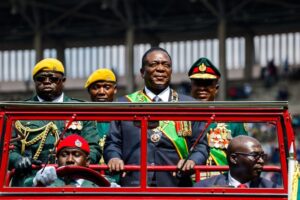
President Emmerson Mnangagwa with some of the men who put him where he is in 2017. How long will their patience last, is a question more and more Zimbabeans are asking?
The people who will pay that price are not the people who choreographed the dance. In Zimbabwe, they never are. But there is a broader warning in this moment that extends beyond economics, beyond constitutional theory, beyond compensation bonds and lithium concessions. A government that passes CAB3 with the ease of a knife through butter, that dismisses every legal, ecclesiastical and civic objection without pausing for breath, is a government that has discovered dissent is irrelevant.
The constitutional manipulation does not stop at CAB3. It has no reason to. That is not a political party governing a country. That is a regime managing a population; and regimes of that character do not bend the rules for the national interest. They bend them for themselves. That is the one conclusion that should frighten everyone, regardless of politics, regardless of tribe, regardless of whether the horse bolted yesterday or forty years ago.
Guest writer, Andrew Field, is the founder and author of the chronicle South of the African Equator and photoblog Simply Wild Photography