 news
newsFrom Scotland with Love: A moving story of an aid agency born at the time the former Yugoslavia was tearing itself apart.
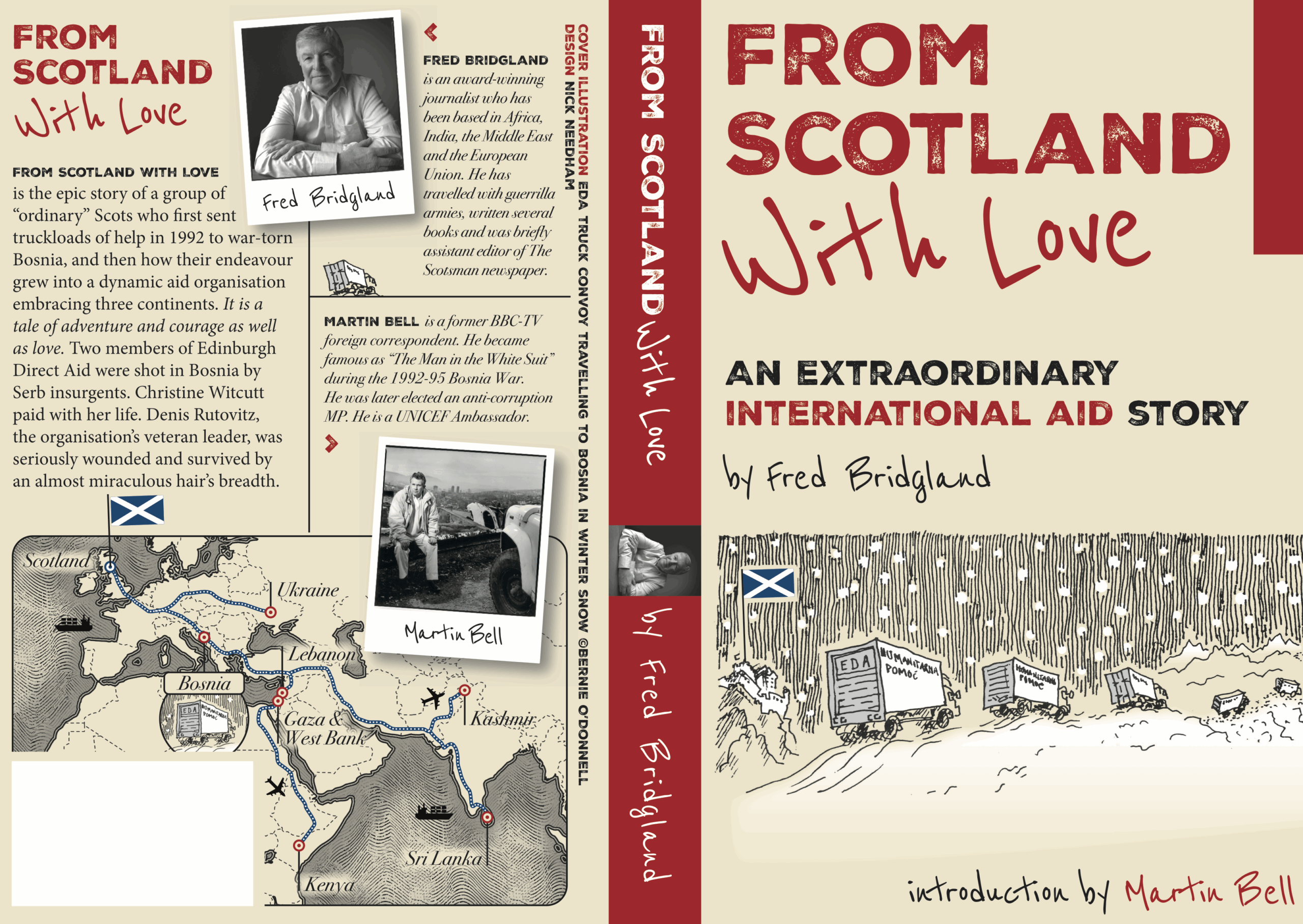
A book that tells how the people who worked for Edinburgh Direct Aid helped the homeless and the and hopeless re-build their lives in war-torn Bosnia. It will will be launched in Edinburgh on Saturday November 1. In it, FRED BRIDGLAND tells how concerned Scots and a handful of journalists helped people with broken lives live again.
Maureen Cerkez was probably the most remarkable person I met in a long career as a foreign correspondent. I got to know her in Sarajevo while researching the biography of an outstanding international aid agency that worked in war-torn Bosnia, the Middle East, South Asia and Africa.
Maureen was the “fixer” and representative in Sarajevo for the agency, Edinburgh Direct Aid (EDA). As I interviewed her, she began telling me, almost by the bye, about her extraordinary rescue mission following the desertion by staff of a home for children at the height of the Bosnia war.
Amid heavy fighting, the entire staff of the home for mentally and physically handicapped children at Fojnica, 30 miles from Sarajevo, had fled, leaving hundreds of kiddies uncared for.

Soldiers take time off from slaughter in the city where the a series of shots from the gun of an anarchist led to the start of one of the First World War ( 1914-1918)
A Canadian Army United Nations peacekeeping patrol stumbled on the home about a week after the staff had left. The patrol reported to UN HQ in Sarajevo that it had found dead and dying children in “squalid and horrific” conditions.
The UN’s chief in Bosnia asked Maureen to head for Fojnica with emergency supplies. She loaded a few UN vehicles with food, medicines, clothing and nappies. “I arrived at the home and was hit by the most awful smell. I found nine children already dead from dehydration and starvation,” she told me. Some of the most severely disabled were dead in baths: without help, they had been unable to get out. She found one dead child with his head stuck in a toilet bowl in an apparent desperate attempt to get some water to drink.
“My first task,” said Maureen, “was to carry the dead kids, some of them young babies, into the garden of the home, dig rough graves and bury them. I was helped by about twenty Canadian soldiers. More children died after I arrived.”

Maureen Cerkez (left) who died in 2019 – a great listener, a great woman who helped save lives and repair broken people after a devastating war in Central Europe
After burying the dead, the priorities of Maureen and the Canadians on that first day were cooking for and feeding 300 children ̶ Bosnians, Serbs and Croats ̶ who had not eaten for more than a week and cleaning them up. The children were literally starving and the overcrowding was appalling, she said. Their clothes were filthy and many were wearing hideously soiled unchanged nappies. “The place was badly wrecked. That first night I slept on a surgical operation table,” she said. “There were still distant Croat snipers taking occasional pot-shots at the building. I was there for two weeks cleaning and comforting the kids and sorting out the wreckage and organising everything with the help of the Canadians.”
Maureen told me she had never dealt before with special needs children. “But I began to love them. They were so good-natured. They had all manner of conditions ̶ Down’s Syndrome, epilepsy, cerebral palsy, various genetic defects, spinal deformities.” Some were blind and some were deaf. All were fragile and deeply disturbed, with complex and compound difficulties.
Maureen alerted Denis Rutovitz, the founder and chairman of EDA, to the needs of the Fojnica children. He sent from Scotland a specialist four-woman special needs team to assess what equipment and supplies were needed. On the team’s recommendations, EDA truck convoys began transporting aid from Scotland to Fojnica.
John Home Robertson, a Westminster Labour Party MP and an EDA volunteer, was one of the drivers on a later truck consignment across 3,000 kilometres from Edinburgh to Fojnica. “It was an alarming experience,” Home Robertson wrote in a memorandum. “Hundreds of children, with every form of physical and mental disabilities, were crammed side-by-side in overcrowded rooms. But to find them close to the front line in a civil war with no electricity, desperately short of food, and with staff (some had returned after fleeing) doing their best with inadequate sustenance and care that had to be sub-basic was appalling.

Fred Bridgland (on right) in Huambo, Angola in 1975. In August that year when he was the Reuters correspondent in southern Africa, he broke the sensational news that South African troops had invaded Angola. Decades down the road, he believes that concerned journalist like Martin Bell and organisations like Edinburgh Direct Aid (EDA) can make the world a better place (Picture by Trevor Grundy)
“I’ll never forget the smell and the screams and shouts of distressed children as I tried to sleep in a truck through a freezing night. But I was impressed by the dedication of those staff who had returned to work without pay and were doing their best to wash great loads of filthy laundry in drums of water heated over bonfires. I was profoundly shaken and I reported back to Denis that we had to do more.”
One typical subsequent EDA aid manifest for Fojnica shows a convoy delivery of 9,000 pounds-weight of high nutrition food and bulk catering supplies, incontinence pads, soap, surgical and dental instruments, nurses’ uniforms and protective over-trousers, disposable cot sheets, 170 pounds-weight of toilet paper, children’s bibs, operating gowns and theatre clothing, anti-biotic and analgesic drugs, anaesthetics, a dental chair, five prams, twelves pairs of crutches and eleven wheelchairs.
EDA also carried out a massive house reconstruction programme in Bosnia. These days it is sending continuous supplies of aid to communities in Ukraine near the front line of the warfare with Russia.
Maureen continued to work tirelessly with umpteen EDA projects in Bosnia, often risking her life. She has since died after a long illness and is buried in a grave in Sarajevo next to her Moslem medical doctor husband Fadil ̶ his resting place marked by an Islamic columnar headstone, hers a Christian gravestone as befitted Bosnia’s multi-cultural Sarajevo.

“From Scotland With Love”, by the Edinburgh-based journalist and author Fred Bridgland (pictured) is a biography of an unusual aid agency. It will be launched at an official ceremony in Edinburgh on 1 November. It can be bought online at Amazon. Anyone wanting to buy the book version should feel free to contact Fred at fred.bridgland@outlook.com (Picture of Fred Bridgland by Trevor Grundy)