 news
Commonwealth and Royal silence over horrendous abuse of African women in Saudi Arabia
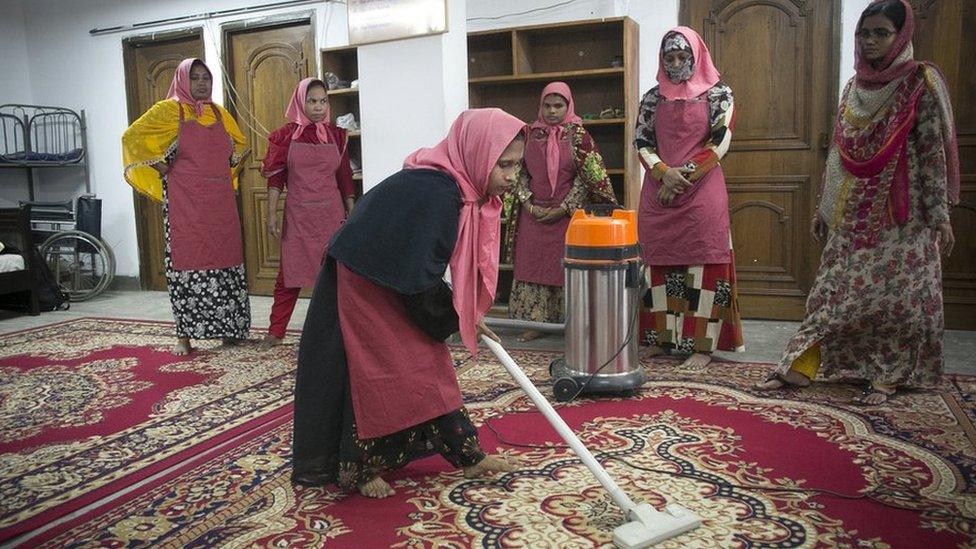
African women are employed as domestic workers in Saudi Arabia. If they break Sharia law, terrifying punishments await them.
If the Commonwealth is to be more than a hat and handbag show featuring royal celebrities and their hangers-on at Westminster Abbey every couple of years, it needs to speak out immediately against people passing draconian sentences on “ club” members and especially on this horrendous case of a Kenyan domestic worker sentenced to 100 lashes for offending Medieval religious laws.
TREVOR GRUNDY writes-
This is a vile and sick-making story. Not because lawyers in Saudi Arabia are acting like Medieval despots (we expect that) but because of the deafening silence from the London-based Commonwealth Secretariat.
Kenya is a leading member of the Commonwealth.
The Commonwealth “club” is rightly proud of its campaigns to end all-white rule in Rhodesia and apartheid in South Africa.
It spoke out so loudly and so clearly when Ian Smith in Rhodesia and John Vorster in South Africa violated human rights.
Have I missed a Commonwealth protest about a Kenyan domestic servant being almost whipped to death in Saudi Arabia?
If I have, please let me know.
What a cowardly and useless institution the Commonwealth has become now that it is no longer able to bang on about racist white Rhodesians and Afrikaners in South Africa.
Why are the Christian vicars, curates and liberals so silent?
Are they frightened of offending the head of the Commonwealth, King Charles 111, who is such a friend of numerous Saudi Arabian princes and billionaires?
One of the few papers in Britain to give publicity to this horrendous case is the ‘Daily Mail.’
Congratulations to the editor.
Don’t let up.
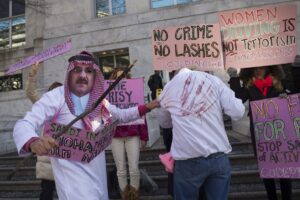
Lashes for men and women in a country where Medieval religious laws are in force
The following is by the respected Kenyan journalist Felix Kipkemoi.
He writes – Kenya has expressed concern over the sentencing of a Kenyan domestic worker to 100 lashes in Saudi Arabia for giving birth outside wedlock, describing the punishment as cruel and inhuman even as it acknowledged the sovereignty of the Gulf kingdom’s judicial system.
Kenya’s Foreign Affairs Principal Secretary Korir Sing’oei said he was ‘saddened’ by the sentence against a woman called Muthoni, who was convicted by a Saudi court after becoming pregnant and giving birth to a child outside marriage.
Sing’oei said Kenya would continue engaging Saudi authorities over the case and other complex issues involving the enforcement of judicial decisions affecting Kenyans abroad.
(Needless to say, Kenya is one of the most important members of the Commonwealth).
According to ‘The New York Times’ Muthoni, aged 40, was sentenced in October this year to 100 lashes after a three-judge panel at a criminal court in Riyadh found her guilty of having sex outside marriage.
The ruling has raised fresh questions about the treatment of vulnerable Kenyan migrant workers in Saudi Arabia and the protection offered by Kenyan diplomatic missions to women facing abuse, exploitation and legal challenges abroad.
According to an investigation by ‘The New York Times’, Muthoni has spent more than a year trying to return home, but has been unable to leave the country because of the criminal proceedings against her.
She had travelled to Saudi Arabia legally to work as a domestic worker when she became pregnant following a brief relationship with an Egyptian resident.
She gave birth in August 2025 at staff accommodation.
A supervisor later discovered her and took her to hospital, where police detained her for questioning over the pregnancy, The New York Times says.
After her release, she was reportedly denied accommodation at the staff housing facility and turned away from a shelter.
She subsequently found refuge at a petrol station that had become a meeting point for migrant mothers stranded with their children.
The New York Times reported that Muthoni received little assistance from the Kenyan Embassy during the initial stages of her ordeal.
Following the newspaper’s investigation last year, Maharah reportedly provided her with accommodation while the Kenyan Embassy issued documents allowing her and her child to leave Saudi Arabia.
However, she remained unable to travel because her criminal case was still pending.
Court proceedings took place over several hearings last summer before the Riyadh criminal court, with the judges relying on an interpretation of Islamic law prescribing 100 lashes for sex outside marriage.
Muthoni told The New York Times that she had been provided with a translator but not a lawyer during the proceedings
According to The New York Times, court documents cited in the investigation did not indicate that she had legal representation.
“I am so afraid. I don’t think I can endure those lashes,” she told the newspaper.
She also expressed frustration over the punishment, saying: “I don’t deserve this.”
The sentence has drawn criticism from labour migration advocates, who argue that punishing women for pregnancies outside marriage further exposes already vulnerable migrant workers to discrimination.
Ekaterina Porras Sivolobova, a labour migration analyst and founder of the non-profit organisation Do Bold, said the punishment was inconsistent with international human rights standards.
“This sentence of flogging does not align with international human rights standards,” she said, adding that it undermined the dignity of women instead of protecting those in vulnerable circumstances.
The case has also exposed questions surrounding Saudi Arabia’s judicial reforms.

King Charles is the head of the Commonwealth and a regular visitor to Saudi Arabia where he is popular with Arab leaders whose financial investments in Britain are vast.
In 2020, the kingdom announced restrictions on flogging, a move widely reported as a major step towards abolishing the punishment.
However, the reforms retained exceptions for offences where flogging is prescribed under interpretations of Islamic law, including sex outside marriage.
Saudi Arabia’s legal system is based on Sharia, with judges interpreting religious provisions in the absence of a comprehensive written penal code.
The court also sentenced Muthoni to one year of banishment.
It remains unclear whether this means she will be deported to Kenya or transferred to another Saudi city.
The Kenyan exit documents previously issued to her have since expired, raising further uncertainty over how she and her child will return home.
Muthoni, a mother of five, did not appeal the ruling, saying returning to Kenya was her priority.
“It is the only way that can take me back home to my children,” she said.
Felix Kipkemoi has been a journalist since 2012 joining Radio Africa group in 2014. He is currently the Radio Africa group correspondent for Bomet.