 news
newsUDI November 11, 1965: Sixtieth anniversary of Ian Smith’s act of defiance that changed the face of southern Africa
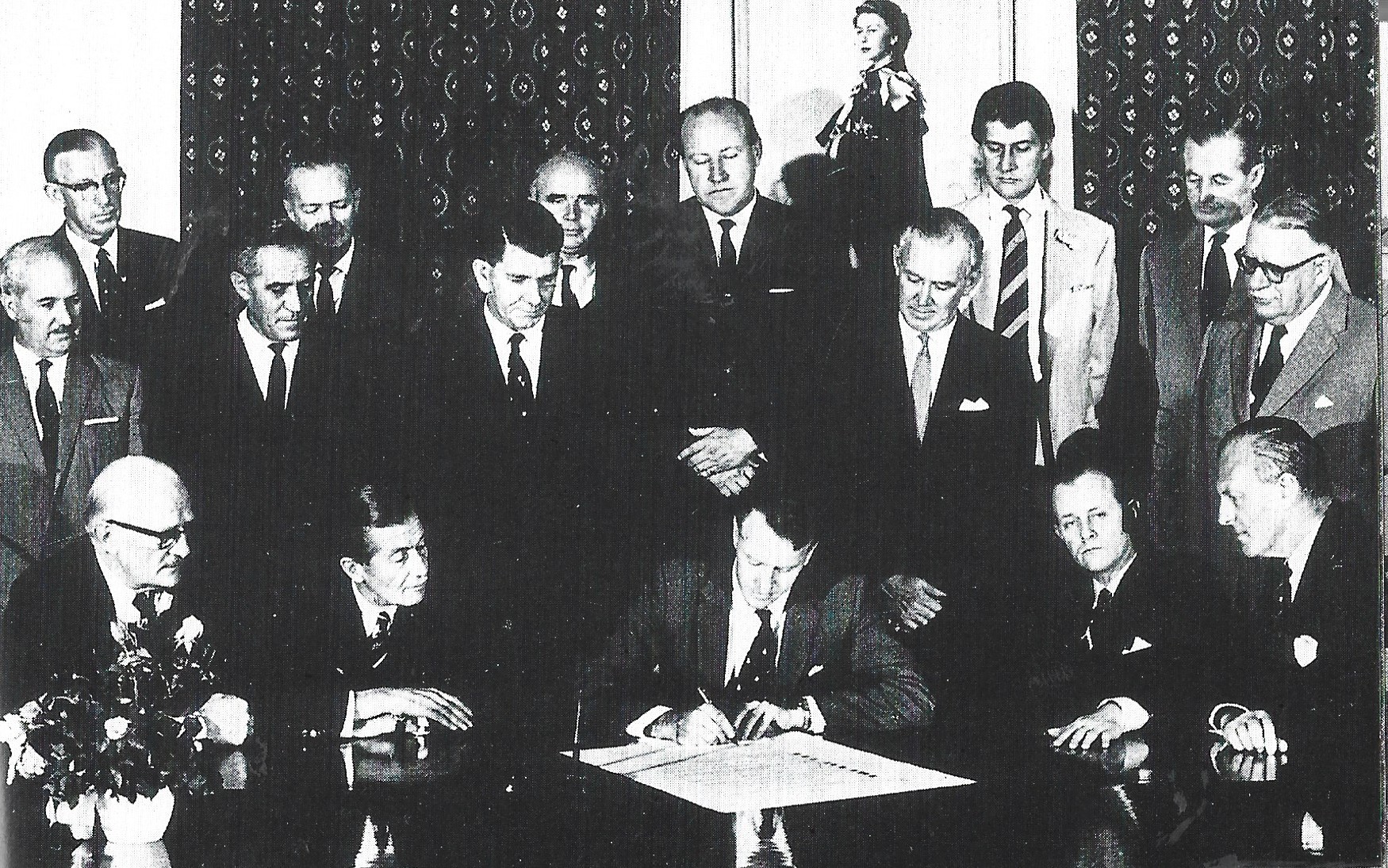
Rich men, in a warm place, sign a document of rebellion against Britain watched over by a poster of Queen Elizabeth 11 in Salisbury on 11 November, 1965 .Picture was issued to journalists by the Information Department, Salisbury, Rhodesia
In 1965, the former RAF fighter pilot and Prime Minister of Rhodesia Ian Douglas Smith promised whites in Rhodesia that he would make sure black terrorists stayed north of the Zambezi until that river ran dry. Fifteen years later in 1980 Robert Mugabe and his guerrilla army were running Zimbabwe.
TREVOR GRUNDY reports –
At a news conference in Lusaka in August 1975, the UNITA leader Jonas Savimbi told journalists that Angola would be an independent country on November 11 that year.
I asked him how Zambians could celebrate, considering November 11 was also the date of Ian Smith’s UDI and no-one in Kaunda’s country was allowed to party on that day.
Savimbi looked up and smiled and said – “I will give you something to make you all forget UDI and Ian Smith.”
How could he have known that 60 years after UDI hardly a soul would remember what it was all about?
After all, it’s not the easiest of stories to understand.
Smith told fellow whites that UDI would make their comfortable Christian lives continue for years.
The British made it clear that they were ready to hand over their former colonies to charismatic leaders with smiles on their faces and AK47s in their supporters’ hands.
That way the Commonwealth would remain under British control.
The Queen would sit more comfortably on a throne. Africans would see their former masters as newfound friends.
Maybe there’s a dozen excellent reasons why UDI happened.
Anyone reading this would have her or his own ideas. I recall one incident that I believe was significant.
For what it’s worth, here it is.
We’re at 1963, two years before UDI.
After Sir James Robertson, the retiring British Governor-General in Nigeria, had attended a cabinet meeting in Downing Street, he and Harold Macmillan exchanged opinions about the future of British colonies in Africa.
British Prime Minister Harold Macmillan was living in a sort of dream world, over -whelmed by personal, as well as political, problems.
Macmillan asked Robertson if the Africans who were demanding independence now, were ready for it. Robertson was the last British governor of Nigeria which attained independence from Britain in 1960.
Along with Tanzania, Nigeria demanded military action against Rhodesia if it ever dared declare its independence.
In those day, Julius Nyerere’s Tanzania was regarded by Western liberals (and the World Bank in Washington) as the mirror of democracy in independent Africa.
Macmillan asked – “When will they be ready?”
Robertson replied- “Twenty years. Twenty-five years.”
Macmillan asked –“What should I do?”
Roberston said – “I recommend you give it (independence) to them at once.”
Macmillan (half asleep) said – “Why? That seems strange.”
“Well, said Roberston, “If they were twenty years well spent, if they (Africans) would be learning administration, if they were getting experience, I would say wait but what will happen?
“All the most intelligent people, all the ones I’ve been training on will all become rebels, I shall have to out them all in prison There will be violence, bitterness and hatred. They won’t spend the twenty years learning. We shall simply have us twenty years of repression and therefore in my view they’d better start learning (to rule themselves) at once.” (1*)
Harold Macmillan went away shaking his head saying later that what Robertson said to him was very sensible.
He was fond of repeating the Governor-General’s words of wisdom. They were soon passed on to Harold Wilson, who carried it with him to Salisbury, when he was PM after the fall of the man once called ”Super Mac.”
In his memoir ‘Transition in Africa: From Direct Rule to Independence’ (Hurst, London 1974) Sir James Robertson said that many senior Americans asked him why Britain had left its colonies in Africa so quickly after the end of the Second World War.
Robertson said it was because of American pressure.
The Americans he spoke to said Britain would have been wise to have resisted that pressure.
But Ian Smith was also influenced by the “wise words” of someone he listened to and respected.
Two worlds of conflicting ideas about Africans collided.
Godfrey Huggins was the prime minister of Rhodesia from 1933-1953.
He told a gathering of Christian missionaries in 1938 that whites had to hold to power or there’d be chaos not only in Rhodesia but throughout Africa.
This is what he said –
“The Europeans in this country can be likened to an island of white in a sea of black, with the artisan and the tradesman forming the shores and the professional classes the highlands in the centre. Is the native to be allowed to erode away the shores and gradually attack the highlands? To permit this would mean that the leaven of civilisation would be removed from the country and the black man would inevitably revert to a barbarian worse than anything before.” (2*)
In his seminal book “A History of Rhodesia” Robert Blake said –
“In practice the natives were allowed to erode away the shores, even though the highlands remained firmly in white hands.”
Artisans and tradesmen and women who said they were worried about being raped by black men gave their full support to Smith and the Rhodesian Front.
Members of the “old money” white elite (most of them rich white farmers with children at English or South African private schools) formed friendships with black politicians, especially those educated at Christian mission stations.
In short, those at the bottom of the heap supported Smith and the Rhodesian Front (RF).
The better-off professionals and “old money” tended to be against any break with the British Crown and government.
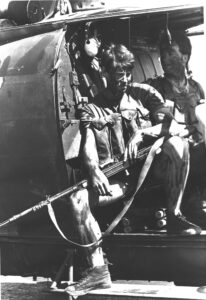
Towards the end – Picture by the late Chris Deon who gave editor Trevor Grundy written permission to use this picture which captures the futility, the pain and the horror of war
Although I have dozens of pictures that could illustrate this short trip down memory lane piece, I have chosen only two.
- One shows a group of rich white men signing a document some called treasonable under the picture of Queen Elizabeth 11.
- The other, a young Rhodesian soldier towards the end of war that cost at least 35,000 lives.
Look at his face and wonder, maybe not for the first time, whether an act of defiance in November 1965 by former RAF pilot who flew so low and so dangerously over what was left of British rule in Africa was worth anything other than the short-term inflation of a stubborn man’s ego.
(1*) Harold Macmillan by Alistair Horne (page 190)
(2*) A History of Rhodesia by Robert Blake (page 228)