 news
newsPoland and Ukraine: The Past is Another Country – but not if you lived there
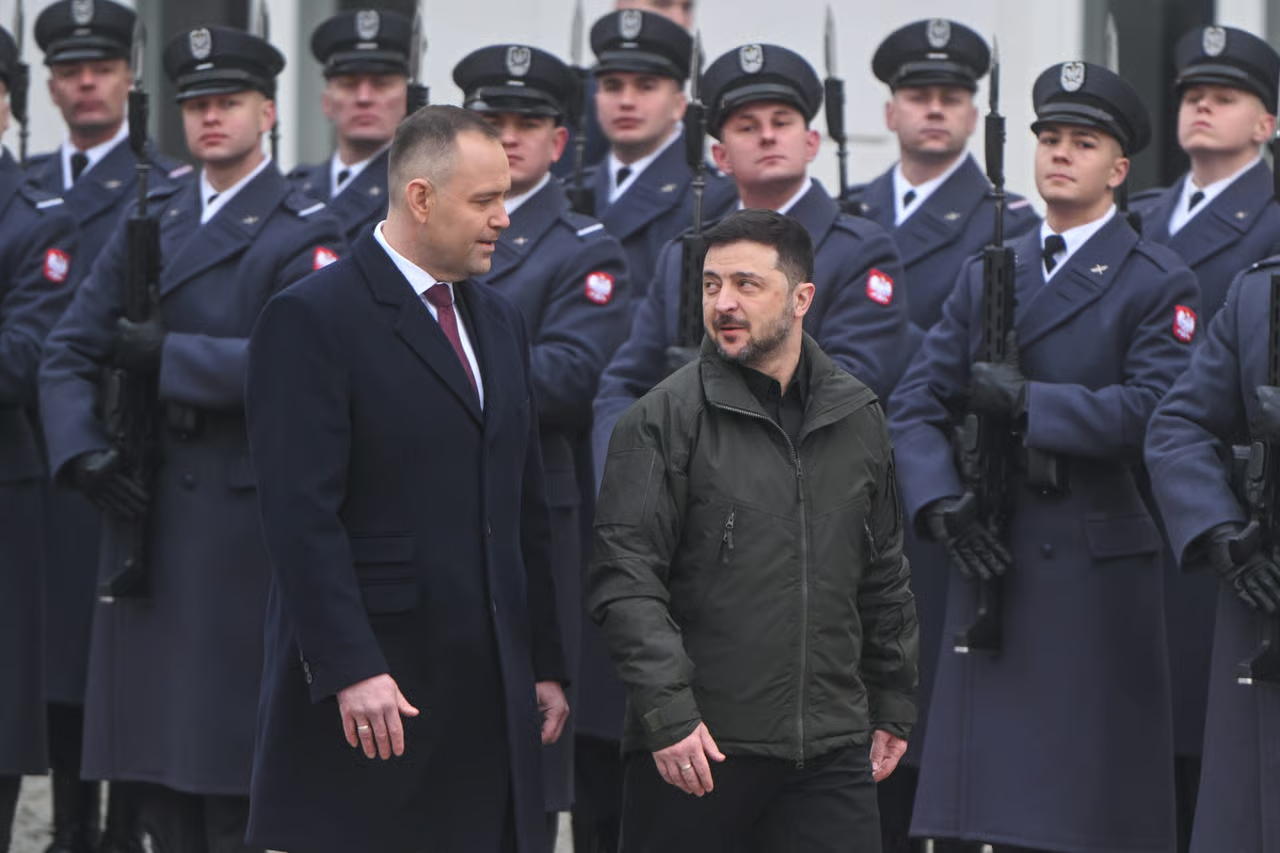
Presidents as pals . . . Karol Nawrocki with Volodymyr Zelensky before the NATO summit in Ankara this month. Zelensky wants ‘in’ to NATO, the Polish leaders says that should not happen.
For Volodymyr Zelensky, what’s happening between his country and Poland could prove to be a lesson too late in the learning. His decision to name a military unit after the Ukrainian Insurgent Army (UPA), which was involved in the death of tens of thousands of Polish men, women and children during the Second World War, has infuriated the Poles who gave massive support to Ukrainian refugees after the Russian invasion of their country in February 2022. TREVOR GRUNDY reports –
The President of Poland, Karol Nawrocki has revoked the Order of the White Eagle, the highest honour of the Republic of Poland that was awarded to President Zelensky by a previous Polish head of state, Andrzej Duda, in 2023.
Political spats between Kiev and Warsaw are nothing new. But this one could endanger the support Poland has given to millions of Ukranians since the Russian invasion four years ago.
President Zelensky received the award in recognition of his contributions to bilateral relations, democracy peace and security in Europe and for steadfastness in defending inalienable human rights after the Russian invasion of Ukraine in 202
President Nawrocki told journalists that that he revoked Zelensky’s award because his countrymen’s pain threshold was crossed after he named a local military unit after the Ukrainian Insurgent Army (UPA).
President Nawrocki said Poland had repeatedly called on Ukraine to change the name of the unit, saying – “In light of President Zelensky’s consent to name one of the units of the Armed Forces of Ukraine ‘Heroes of the UPA’ I have decided to revoke the Order of the White Eagle from the President of Ukraine. Remembering the victims is a moral obligation of the Polish state.”
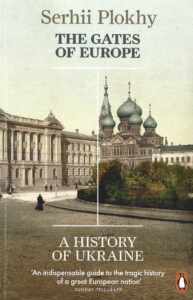
In ‘The Gates of Europe – A History of Ukraine’ (Penguin, 2015), the distinguished Ukrainian historian, Serhii Plokhy, provided some of the background to the Polish/Ukrainian “spat“ and writes –
He writes – “While they regarded the Germans as their main enemies, in 1943 the UPA mostly fought the Polish insurgency.”
The long history of the animosity between Ukrainians and Poles in Volhynia and Galacia exacerbated each side’s mounting suspicions of the other’s intentions, and led in the spring and summer in 1943 to mass a actions of ethnic cleansing involving the burning of villages and mass murder of innocent civilians.”
This respected Ukrainian historian said that there is no doubt that the most victims of the ethnic cleansing were Poles.
Estimates of Ukranians killed as a result of Polish actions in Galicia and Volhynia vary between 15,000 and 30,000, whereas the estimate for Polish victims are between 60,000 and 90,000 – two to three times as high.
“The Germans originally tried to stop the military conflict in their rear, but ended up supplying weapons to the combatants. If they could not control the countryside, they could at least keep their enemies divided. They also benefited from UPA operations against the advancing Red Army.”
Most of the world has either forgotten – or never knew – about these terrible days in Poland.
Or gone to sleep with that idiotic saying on their lips -The Past is Another Country.
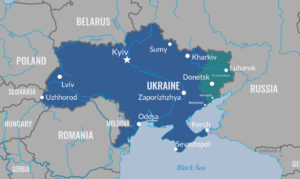
The massacres he referred to took place mainly at Volhynia (now Volyn) and Eastern Galicia lying between Poland and Ukraine. It became a crossroads for two great powers during the Second World War.
In ‘Europe – The struggle for supremacy 1453 to the Present,’ historian Brendan Simms painted a picture of a furious Hitler after he had been rebuffed by the Poles as an on-paper ally of the Third Reich and a joint partner in an invasion of the Soviet Union.
Simms says – ”In return for Danzig and military co-operation – including transit across Polish territory to attack Russia – Warsaw would receive lands in the Ukraine. To Hitler’s surprise and immense irritation, the Poles refused his invitation. The Poles stood between him and the ultimate security he craved: special depth in the Russian interior. If the Soviet Union were to be attacked, Poland would have to be crushed. With breathtaking audacity, Hitler now turned to Stalin to eliminate the last barrier to attacking him.”
After the Molotov-Ribbentrop non-aggression pact of 1939, Poland was divided between Nazi Germany from the west and Stalin’s Soviet Union from the east.
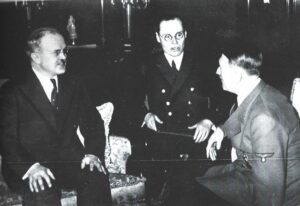
Hitler with Molotov (left) after the non-aggression pact was signed between Germany and the Soviet Union in August 1939. Hitler spent a good deal of the summer and autumn of 1942 and the spring of 1943 in Ukraine. He left in November that yea when Soviet troops recaptured Kyiv.
The area was the stomping grounds for various nationalist units seeking the dreams of independence. Ukrainians in Poland saw UPA as the knife that would cut and shape their ambitions for a strong, free from Berlin and Moscow, Ukraine.
Poles had their own dreams.
Say hello to one of Central Europe’s longest forgotten tragedies.
People who once lived alongside one another become deadly enemies.
The UPA was utterly ruthless and the French President Charles de Gaulle is routinely cited as chief witness to the power of these Ukrainian nationalists and sometime Nazi collaborators having said (quoted in Rolf-Dieter Muller’s The Unknown Eastern Front -The Wehrmacht and Hitler’s Foreign Soldiers (IB Tauris, London 2012) that never would a German had set foot on French soil had France an army as committed as the UPA in 1940.
At the start of war in September 1939, most Ukrainians saw the invading German army as liberators who would destroy Stalin who had organised the starvations of millions of Ukrainians in the 1930s.
Many Ukrainians of all ethnic backgrounds perished in the Great Purge between 1936-1940.
Plokhy estimates that as many as 270,000 were arrested in Ukraine in 1937 and 1938 and close to half of them were executed.”
It didn’t take them long to grasp that the Nazis were as bad, if not a lot worse, than the Communists.
German “order” descended into lawless chaos with Poles and Ukranians turning on one another.
Revoking the honour does not mean Poland will automatically reduce aid to its gallant neighbour.
Millions of Ukrainians were given help by the people of Poland. There are still over one million Ukrainians living in Poland.
But any public row (like this one) is oxygen to Vladamir Putin in the Kremlin.
In Kyiv, a Ukrainian Foreign Minister spokesperson said it is ‘unfortunate’ that there has been such a negative reaction in Poland after naming the military unit after UPA.
Prime Minister Donald Tusk said that the winners of a split between Poland and Ukraine would be the Russians.
He said both sides needed to calm down, not to stoke tensions.
Easier said than done.
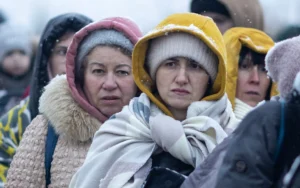
It is reported that by the end of 2025, about 38 million 800 thousand people lived in Poland. The number of foreign citizens was about 2 million 300 thousand inhabitants of the country. About 73% of all foreigners in Poland are citizens of Ukraine – about 1.675 million.
A report I the academic journal “The Conversation” (July 1, 2026) written by Artur Nadiev, described Nawrocki as a right-wing populist.
The Polish leader is an admirer of Donald Trump. Like Trump, he uses emotive language to further his aims. He has already started a campaign for next year’s parliamentary elections and is rallying for his Law and Justice party (PiS) by playing up old hatreds. Before being elected, Nawrocki promised to block Ukraine’s admission to NATO. He is also spoke out against Ukraine’s membership of the European Union.
Said Marx – “History repeats itself. First as a tragedy, second as farce.”
But there’s nothing farcical about what’s happening in Poland.